

A kitten's exact age is rarely something you know for certain unless you were there for the birth. Whether you found a kitten under a porch in Lahore or brought one home from a friend's litter in Karachi, the clues are physical: eye color, ear position, teeth, weight, and coordination all shift on a fairly predictable timeline. A veterinarian remains the most reliable source for confirming kitten age, especially when health or feeding decisions depend on getting it right.
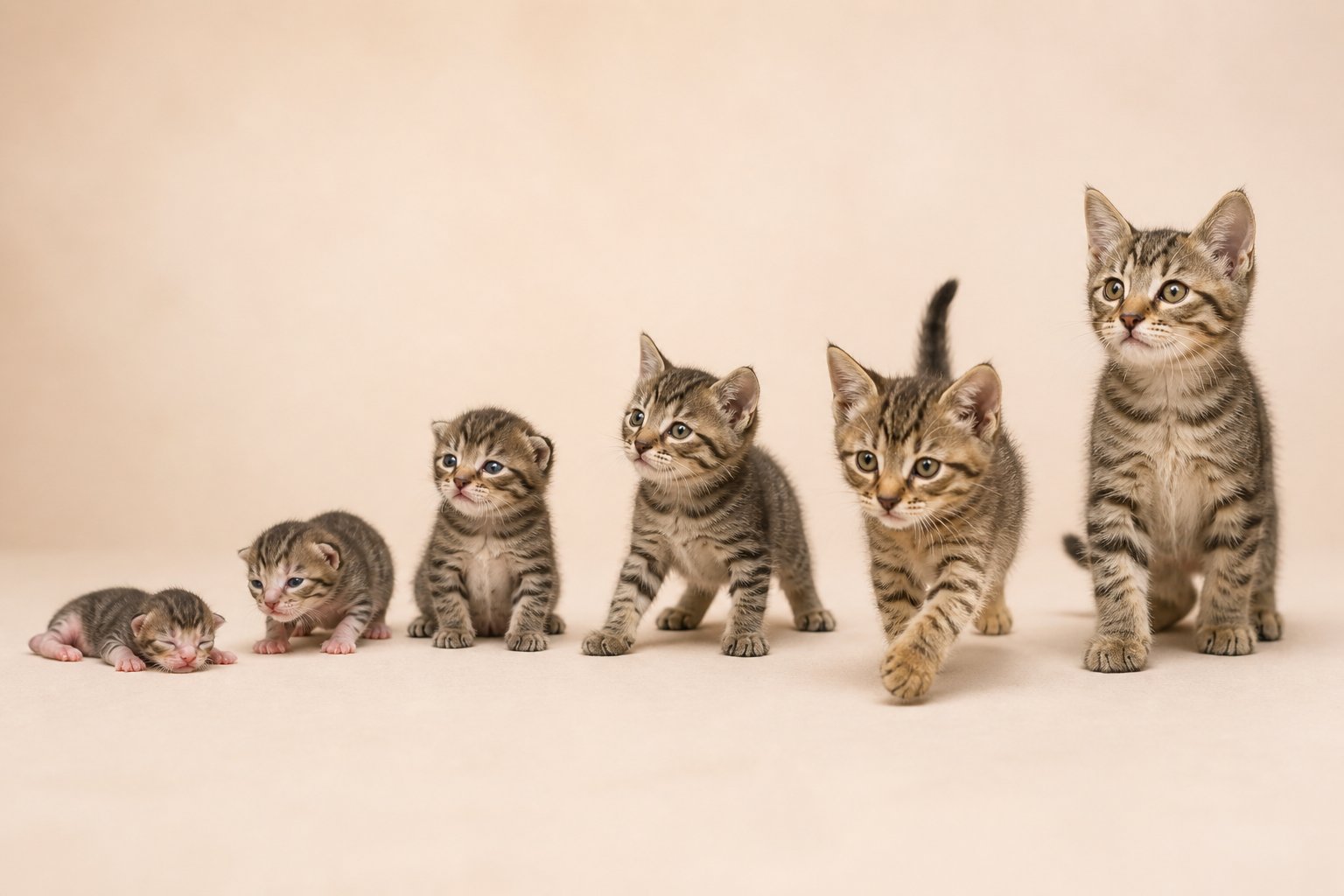
A kitten age chart gives you a starting point, not a diagnosis. Newborns and older kittens have such different care needs, from round-the-clock bottle feeding to litter box independence, that even a rough estimate changes what you should do next. Getting the stage right matters more than getting the exact day right, and that's what the guide below is built to help you do.
Week-by-Week Growth and Care Guide
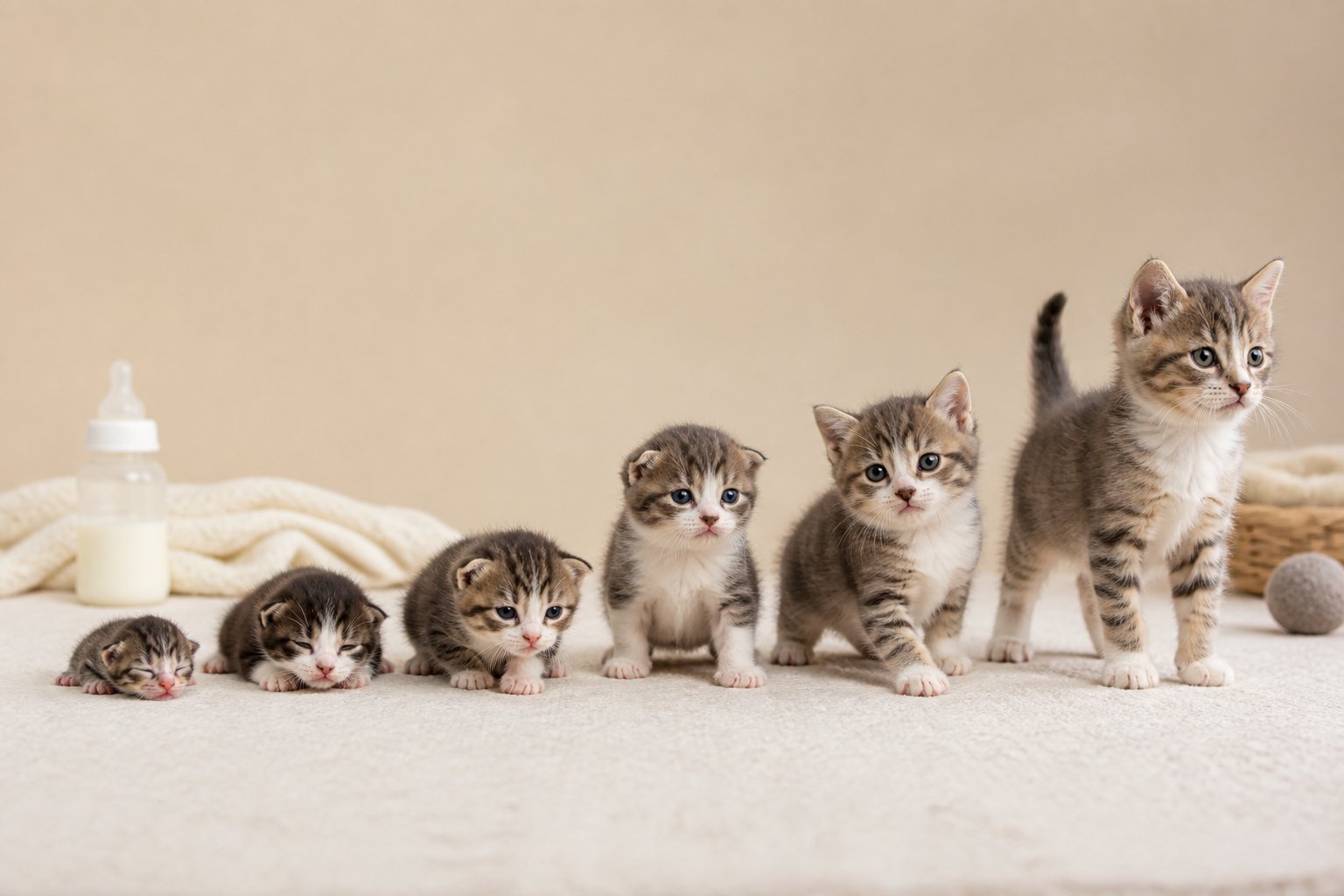
A kitten age chart works best when you track several signs together rather than relying on one alone: weight, eye and ear development, teeth, mobility, and feeding stage all shift on their own timelines but tend to cluster around the same weekly windows. Newborn kittens weigh 3 to 5 ounces and cannot see, hear, or regulate their body temperature, while an 8-week-old kitten is walking confidently, eating solid food, and often ready for adoption.
|
Age |
Weight (approx.) |
Eyes/Ears |
Teeth |
Mobility |
Feeding |
|---|---|---|---|---|---|
|
0-1 week |
3-5 oz |
Eyes closed, ears folded |
None |
Cannot stand |
Nursing/bottle every 2 hours |
|
2 weeks |
~8 oz |
Eyes open, ears unfolding |
None |
Crawling, wobbly |
Nursing/bottle, 4-5x daily |
|
3 weeks |
~10-12 oz |
Eyes fully open |
Baby teeth emerging |
Walking unsteadily |
Start wet food/formula mix |
|
4 weeks |
~1 lb |
Fully alert |
Front teeth visible |
Sturdy walking, playing |
Wet food introduced |
|
5 weeks |
~1.25 lb |
Fully developed |
More baby teeth in |
Running, pouncing |
Weaning underway |
|
6 weeks |
~1.5 lb |
Adult-like vision |
Most baby teeth present |
Confident, agile |
Mostly solid food |
|
7 weeks |
~1.75 lb |
Fully mature |
Full set of baby teeth |
Coordinated play |
Eating independently |
|
8 weeks |
~2 lb |
Fully mature |
Baby teeth complete |
Fully mobile |
Weaned, solid food only |
Newborn to 2 Weeks: Closed Eyes and Complete Dependence
Neonatal kittens in this window cannot see, hear well, or keep themselves warm. Their eyes stay closed for roughly the first week to ten days, and their ears remain folded flat against the head. A newborn kitten needs its mother (or a caregiver) for every feeding, every bathroom trip, and constant warmth, since they cannot regulate body temperature on their own.
3 to 4 Weeks: First Teeth, Wobbly Steps, and Litter Introduction
By 3 weeks, tiny baby teeth start breaking through the gums, and a 3-week-old kitten begins taking real, if unsteady, steps. A 4-week-old kitten looks like a miniature version of an adult cat, with a fuller coat and much sturdier legs. This is the stage to introduce a low-sided litter box, since kittens this age can start eliminating without help.
5 to 6 Weeks: Active Weaning and Confident Play
A 5-week-old kitten is usually deep into weaning, sampling wet food several times a day while still nursing occasionally. By 6 weeks, most kittens are running, pouncing, and wrestling with littermates, showing the kind of coordinated play that signals their motor skills are nearly fully formed.
7 to 8 Weeks: Independent Eating and Adoption Readiness
A 7-week-old kitten eats solid food without much prompting and has largely stopped nursing. An 8-week-old kitten typically weighs around 2 pounds, has a full set of baby teeth, and is considered old enough for adoption in most shelter and rescue guidelines, provided it has had an initial veterinary check.
How Can You Estimate a Kitten's Age?
Age estimation relies on reading several physical signs together, since no single trait tells the whole story. Kitten eyes, kitten teeth, weight, and coat texture each follow a rough timeline, but illness, malnutrition, or a small litter size can shift any one of them independently.
What Kitten Eyes and Ears Reveal
Kitten eyes stay closed for about the first week and begin opening between days 7 and 10, though full focus takes a few more weeks to develop. Ears follow a similar pattern, folded flat at birth and gradually unfolding to stand upright by around 3 weeks. All kittens are born with blue eyes, and true adult eye color does not settle in until close to 2 months of age, so blue eyes alone only tell you a kitten is younger than 8 weeks.
Using Baby Teeth and Adult Teeth as Age Clues
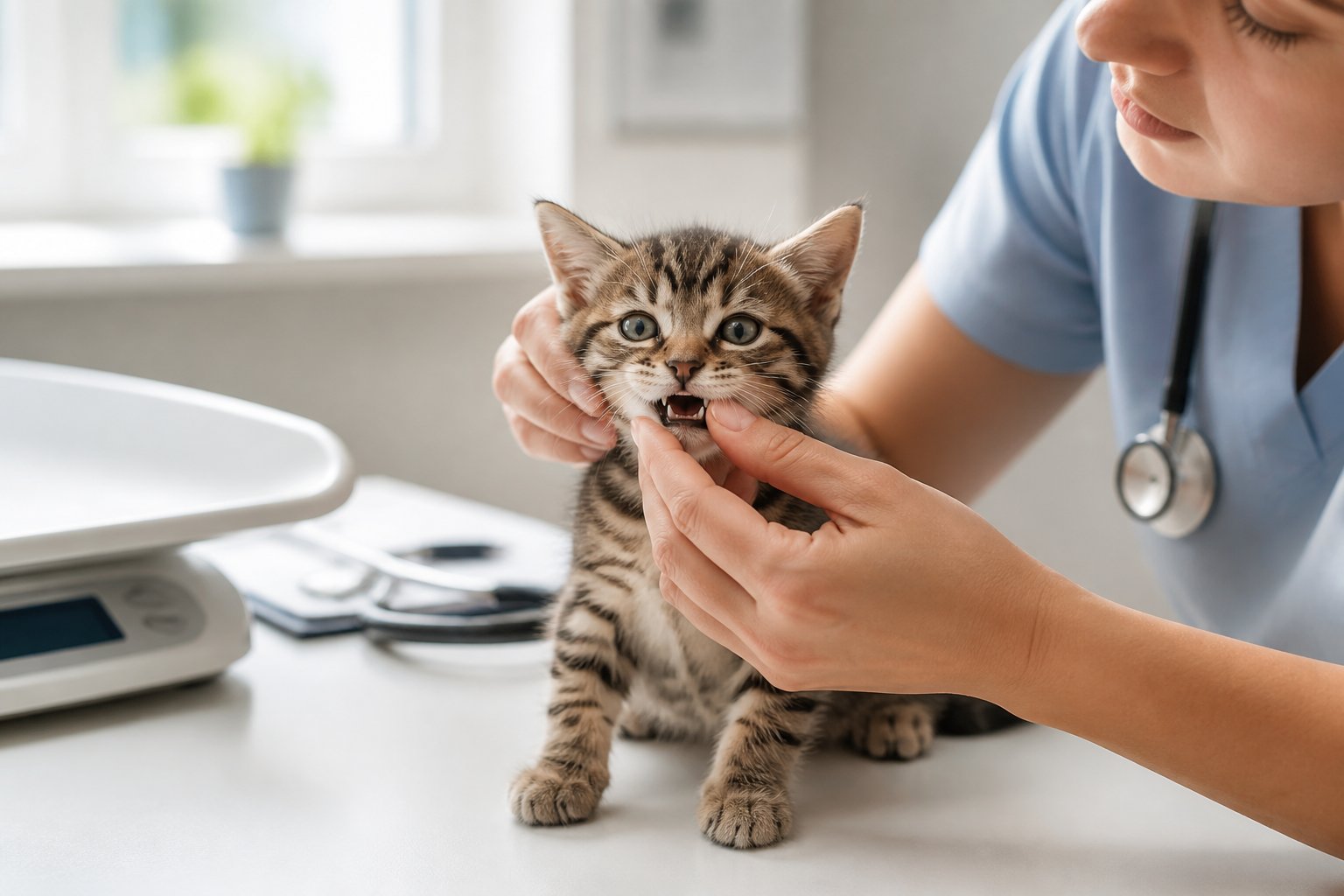
Baby teeth start emerging around 3 weeks, beginning with the small front incisors, and a full set of baby teeth is usually in place by 6 to 8 weeks. Adult teeth do not begin replacing them until around 3 to 4 months, so a kitten with a complete mouth of tiny baby teeth and no adult teeth is almost always under 4 months old. Vets often use tooth eruption as one of the more reliable age markers because it changes on a fairly fixed schedule.
Why Weight and Mobility Need Context
Kitten weight is a useful guide, but a malnourished kitten can weigh far less than its actual age suggests. A kitten from a large litter, or one that lost access to its mother early, may lag behind the typical growth curve even though its teeth and eyes point to an older age. Cross-check weight against teeth and coat development rather than relying on the scale alone.
Coat Changes From Kitten Fur to an Adult Coat
Young kittens have a soft, downy coat that gradually thickens and coarsens as they approach 3 to 4 months old. The shift toward an adult coat texture, along with the loss of the last baby teeth, signals a kitten is moving well past the newborn and weaning stages described in the chart above.
Care Needs at Each Early Life Stage
Care needs shift dramatically between a newborn kitten that cannot regulate its own body heat and a weaned kitten ready to explore a litter box and cat trees on its own. Matching feeding, warmth, and handling to the correct stage prevents the two most common risks in young kittens: hypothermia and aspiration during feeding.
Caring for Orphaned Newborn Kittens
Newborn kittens separated from their mother cat need supplemental heat, since they cannot maintain body temperature until around 3 to 4 weeks old. A heating pad set on low, covered with a towel, works well under one side of the nesting box so the kitten can move away from the heat if needed. Handle them gently and keep stress low; at this stage, warmth and correct feeding volume matter more than anything else.
When to Use Kitten Formula and Begin Wet Food
Kitten formula is the only appropriate substitute for a mother cat's milk; cow's milk causes digestive upset and should never be used. Bottle feeding continues roughly every 2 hours for the first week, stretching to every 3 to 4 hours by 2 to 3 weeks old. Around 3 to 4 weeks, start introducing wet kitten food mixed with a small amount of formula to ease the transition toward solid meals.
Litter Box Training, Play, and Early Socialization
Litter box training can begin around 3 weeks old, once kittens are mobile enough to climb into a low-sided box. A shallow tray with unscented, non-clumping litter works best at this stage, since kittens may sample the litter out of curiosity. From 5 weeks onward, supervised play with toys and eventual access to cat trees helps build coordination and confidence, while regular gentle handling by different people supports healthy socialization.
When a Veterinarian Should Assess Your Kitten
A veterinarian should examine any kitten within the first few days of being found or adopted, regardless of how healthy it appears. Early vet visits catch parasites, infections, and nutritional gaps before they become serious, and they give you a confirmed age estimate instead of a guess.
First Wellness Visits, Deworming, and the FVRCP Vaccine
Kittens typically start their first round of deworming around 2 to 3 weeks old, since intestinal parasites are common even in kittens that appear healthy. The FVRCP vaccine, which protects against feline viral rhinotracheitis, calicivirus, and panleukopenia, usually begins around 6 to 8 weeks old, with follow-up boosters every 3 to 4 weeks until 16 weeks. A vet visit at this stage also confirms weight gain is on track for the estimated age.
Warning Signs in a Cold, Weak, or Underweight Kitten
A cold, weak, or malnourished kitten needs veterinary attention immediately, not a wait-and-see approach. Signs that warrant an urgent call include a body that feels cool to the touch, limpness, refusal to nurse or bottle-feed, or a kitten crying persistently without settling. Neonatal kittens decline quickly compared to older cats, so a delay of even a few hours can matter.
Why Kittens Should Stay With Their Mother When Possible
Kittens fare best staying with their mother cat until at least 8 weeks old, since her milk provides antibodies and nutrition that formula cannot fully replicate. If you find kittens outdoors and the mother is nearby, monitor from a distance for a few hours before intervening, since she may simply be out foraging. Separating kittens from a capable mother too early increases the risk of health and behavioral problems later.
Match Care to the Kitten in Front of You
A kitten age chart gives you a framework, but the kitten in front of you is the real reference point. Two kittens born the same week can differ in weight, teeth, and coat depending on litter size, mother's health, and nutrition, so treat the chart as a guide for what to check, not a fixed rulebook.
Watching kitten development closely, tracking weight, teeth, and behavior together, gives you a far more accurate picture than any single sign on its own. When something doesn't add up between the chart and what you're observing, a vet visit resolves the uncertainty quickly. Raising a kitten well starts with knowing roughly where it stands on this timeline and adjusting feeding, warmth, and handling accordingly.
Frequently Asked Questions
How can I tell how old a kitten is if I do not know its birthday?
Check eyes, ears, teeth, weight, and mobility together rather than relying on one trait. Closed eyes and folded ears point to under 2 weeks old, while a full set of baby teeth with steady walking suggests 6 to 8 weeks. A veterinarian can narrow the estimate further using a physical exam.
When do kittens open their eyes?
Kitten eyes typically begin opening between 7 and 10 days old, though the exact timing varies by a few days between litters. Full focus and coordinated eye movement take another week or two to develop. All kittens have blue eyes at this stage, regardless of their adult eye color.
How much should an 8-week-old kitten weigh?
An 8-week-old kitten weighs around 2 pounds, though this can vary based on breed and litter size. A kitten significantly below this weight at 8 weeks may be underweight or slightly younger than estimated. A vet can weigh the kitten and check for signs of malnutrition or illness.
When can kittens start eating wet kitten food?
Kittens can start sampling wet kitten food around 3 to 4 weeks old, mixed with a small amount of formula to ease the transition. By 6 to 7 weeks, most kittens eat wet food independently without needing formula mixed in. Fresh water should be available alongside solid food from this point on.
At what age can a kitten leave its mother?
Kittens should stay with their mother cat until at least 8 weeks old, and many veterinarians recommend waiting until 10 to 12 weeks. Early separation removes access to maternal antibodies and can affect social development. Shelters and breeders in Pakistan and elsewhere generally follow the 8-week minimum before adoption.
What should I do if I find a newborn kitten alone?
Watch from a distance for a few hours before intervening, since the mother cat may be out searching for food. If she does not return, or the kitten appears cold, weak, or injured, move it to a warm, quiet space and contact a veterinarian right away. Newborn kittens without a mother need supplemental heat and kitten formula, never cow's milk, until professional care is arranged.
0 comments